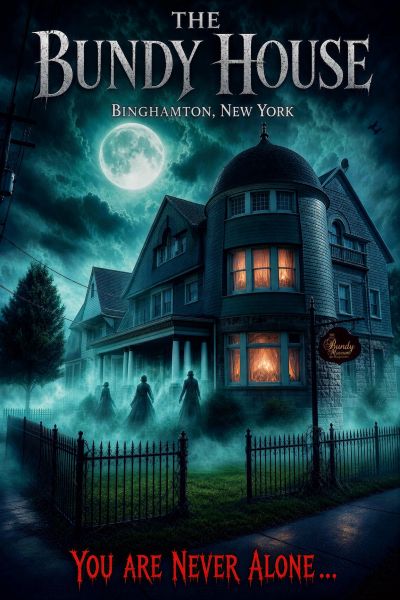
the Historic Bundy House
129 Main Street • Binghamton, New York
This Queen Anne–style frame dwelling built between 1892-1893 for Harlow and Julia Bundy along with their children. A Binghamton businessman and founder of the Bundy Manufacturing Company, a predecessor of IBM . The home was designed by architect Elfred Hull Bartoo and features decorative shingles, cut stone veneer, and a conical corner tower.
The home has had several owners over the years. A few of those owners, family members and servants are still there. After the Bundy family left, the house was occupied by two other families until 1942, when the last resident, Elizabeth Hopton, passed away It then went through periods of vacancy, serving as a boarding house, office space, and even a printing shop.
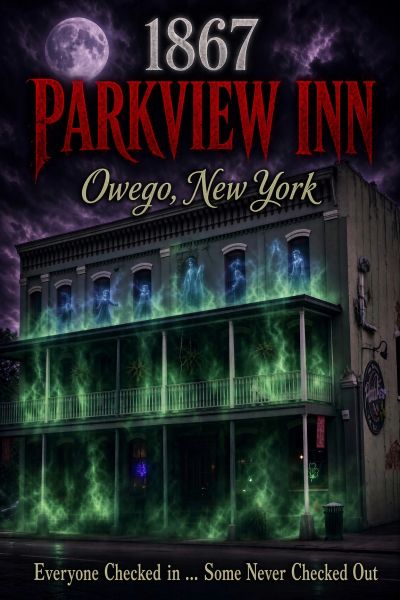
the 1867 Parkview Inn & Dugan House Pub
145 Front Street • Owego, New York
The Parkview Hotel in Owego, NY, is one of the oldest continuously operating businesses in the village, with roots dating back to 1867. Its story begins when the Cameron brothers built the Exchange Hotel in 1867, which burned down on October 5 of that year. A granite slab embedded in the wall read: “Burnt by the torch of vile incendiaries & thieves Oct 5, 1867. Rebuilt & occupied by R. Cameron & sons Jan 1, 1868”
In 1867, the Camerons hired Hugh Dugan, an Irish immigrant, to manage the rebuilt hotel. Dugan later purchased the property in 1882 for $7,500 and renamed it the Temperance House. After his death in 1885, his widow and son operated it as the Dugan House until it was sold in 1909 to Isaac Norton and William F. Barry
The hotel changed hands several times in the early 20th century, including ownership by Charles E. and Lillian Page, who renamed it the Page Hotel. In 1946, John and Rose Kaufelt bought it, painted it red, and renamed it the Park Hotel In 1972, Clyde Barnes, Leo VanWie, and Joseph McTamney became joint owners, and Joseph and Louise McTamney adopted the name Parkview in 1972, running it for nearly four decades.
The property is known for paranormal activity, including the legend of Marguerite, a two-year-old who died in a 1909 fire, and the spirit of Floyd Hooker, a St. Patrick’s Day lottery winner.
In 2011, Beth and Mark Johnson took over ownership.
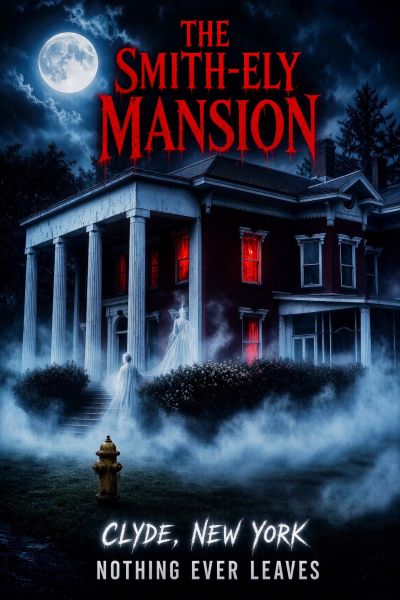
the Smith-Ely Mansion
39 West Genesee Street • Clyde, New York
Built in 1858, the Smith-Ely Mansion is a 12,000 square foot Classical Revival masterpiece listed on the Department of the Interior's National Register of Historic Places.
With 12 fireplaces featuring imported marble and mahogany and teak mantles, 23 chandeliers, stained glass windows, parquet floors, and gold leaf wall coverings — every detail reflects an era of uncompromising craftsmanship.
In 2008, local investor Mark Wright purchased the property, restored it, and converted it into a bed and breakfast called The Erie Mansion Inn. The inn retains its historical integrity, offering themed suites, guided tours, and event rentals.
Today, it stands as both a historic landmark and a luxury heritage destination, blending preservation with hospitality
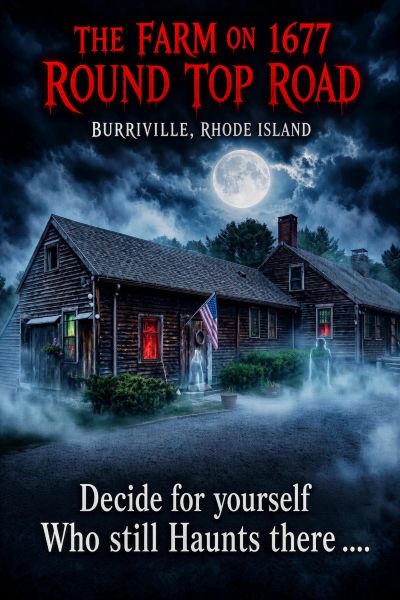
the Farm on 1677 Round Top Road
1677 Round Top Road • Burrillville, Rhode Island
Built in 1736 this farmstead would be the home for eight generation of the Arnold family, until it was sold in 1971. In recent years this location has been know as the "Conjuring House" made notorious by the movie The Conjuring.
In July of 2020 we were able to investigate this location with the assistance of Casey Colburn (a seasoned Investigator out of the Jamestown area) and Alfredo "Danger Boy" Travieso (a local celebrity from RI)
While there is activity at this location ... enough to be Authenticated as haunted ... it was no where near the lever of Hollywood would have you believe.
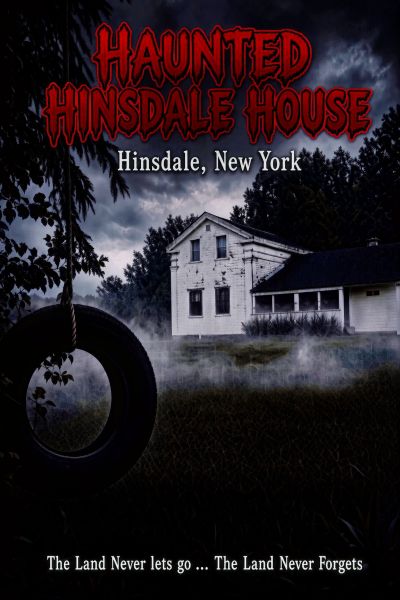
the Haunted Hinsdale House
3830 McMahon Road • Hinsdale, New York
Built in 1853 by brothers Charles and David Everett this modest wood-frame farmhouse that sits on land believed to be the site of a 1799 Native American massacre
Activity on the land ... in the woods ... and in the house is well documented by ourselves and hundreds of other visitors and teams over the years. There is a presence, an entity that roams the land ... visits the house ... and it has been there for a very long time.
While there are times that the is activity at this location is minimal ... this location should never be underestimated. Always be cautious when visiting or investigating this property.
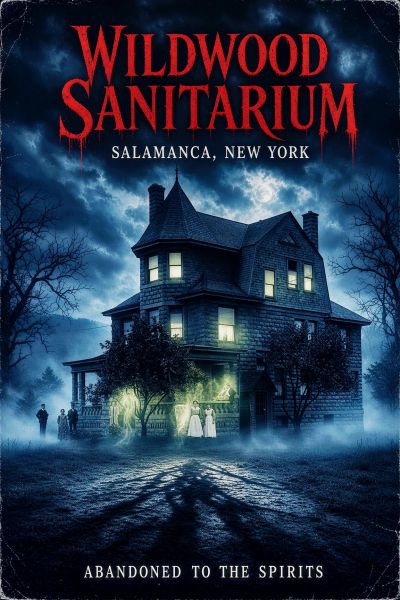
the Wildwood Sanitarium
71 Prospect Ave. • Salamanca, New York
Built in 1900, the property was purchased in 1906 by Dr. John Henderson and Dr. Carol (Carroll) Perry, both trained in osteopathy — a branch of medicine emphasizing manipulation, massage, and holistic healing of bones, joints, and muscles. The two doctors, along with four nurses (Bertha, Agnes, Sue, and Violet), prepared the building to house 15 full-time patients and visitors seeking treatments.
Opening and Services In fall 1909, it opened as a Private Holistic Osteopathic Infirmary. It was advertised as the only osteopathic infirmary in New York State and was “not a fashionable resort, but a place to heal”. Treatments included cold baths, hot baths, electric battery baths, light bath therapy, and other homeopathic remedies. It welcomed patients with a wide range of non-contagious conditions, including drug addiction, alcoholism, mental health issues, and other non-infectious
It is known for reported paranormal activity — shadow figures, orbs, electronic voice phenomena, and physical sensations — and offers ghost tours, daytime investigations, and overnight paranormal hunts
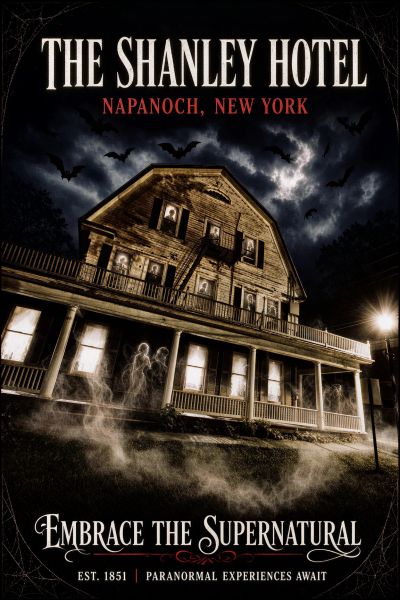
the Shanley Hotel
56 Main Street • Napanoch New York
Built in 1845 as Ritch’s Hotel by Thomas Ritch, serving travelers escaping the city and benefiting from the nearby railroad. In 1851 it became Hungerford’s Hotel, still catering to the elite and even hosting a gentlemen’s club and bordello.
A nearby fire destroyed the hotel in 1895, but owner Adolph Wagner rebuilt it within months
In 1906, Irish immigrant businessman James Shanley purchased the property, adding a bowling alley, billiard room, barber shop, and beauty salon. Under his ownership, the hotel became a social hub for the town’s elite, hosting high-profile guests such as Eleanor Roosevelt, President Theodore Roosevelt, and Thomas Edison.
It also hosted gangsters, madams, and bootleggers during Prohibition, with rumors of hidden passages and a secret room used for smuggling liquor.
James married Beatrice Rowley in 1910; their three children died in infancy, a tragedy often linked to the hotel’s haunting which include Beatrice Shanley (“Weeping Woman”) searching for her lost children. Rosie Greger, daughter of the barber, and other spectral figures. There have been reports of children’s laughter, spectral footsteps, and even unexplained chokes.
Children are often banned from staying overnight due to the intensity of the hauntings
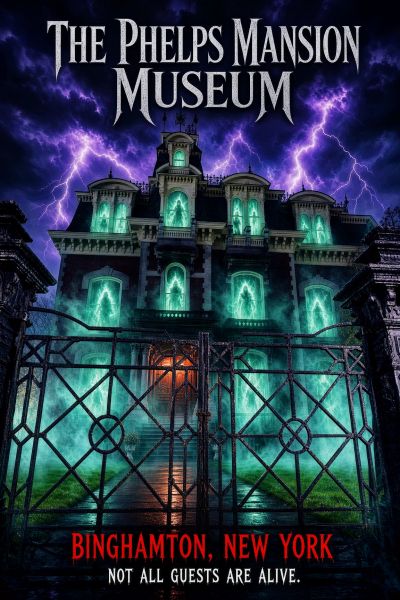
the Phelps Mansion Museun
191 Court Street • Binghamton, New York
The only surviving example of the city’s “Mansion Row” from the Gilded Age . Built in 1870 for Sherman David Phelps, a successful banker, entrepreneur, and the city’s fifth mayor (1872–1873), it was designed by renowned architect Isaac G. Perry, who also worked on the New York State Capitol
Sherman D. Phelps, his wife Elizabeth, and their children lived there until 1882, when all immediate family members had passed away.
In 1905, the property was purchased by the Monday Afternoon Club, a women’s civic organization focused on education, philanthropy, and social reform. The club added a large ballroom and used the mansion for over a century, preserving its historic integrity.
In 1986, ownership passed to the Phelps Mansion Foundation. In 2005, it was chartered as a museum by the New York State Board of Regents. The Monday Afternoon Club disbanded in 2006, and the mansion was transferred to the Phelps Mansion Museum.
Footsteps, shadow figures and non-functional clocks that still chime are just some of the activity at this location.